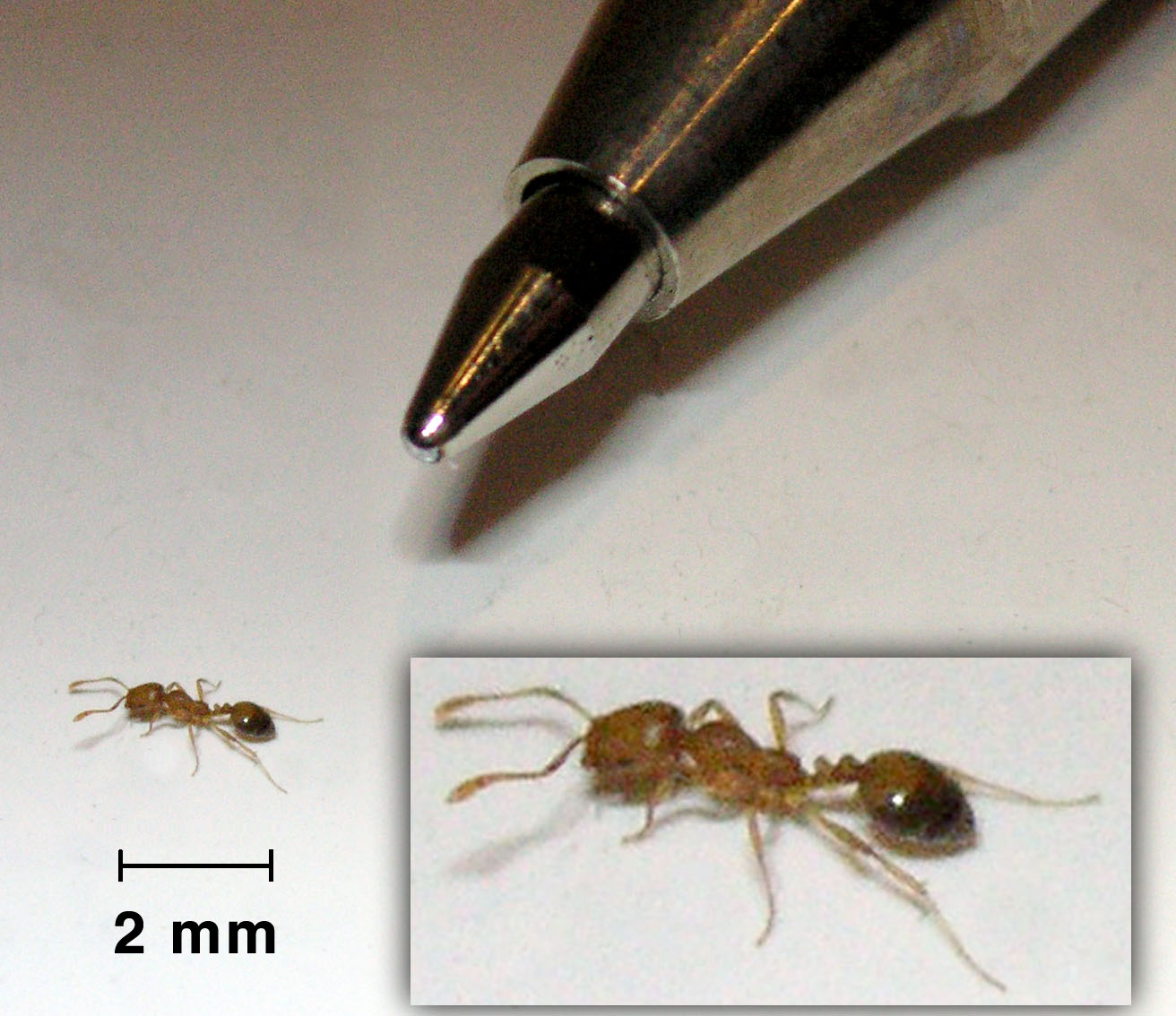
Identification
Tiny (1.5–2 mm), pale honey-yellow with a darker gaster tip, two petiole nodes, and a 12-segmented antenna with a very distinct 3-segmented club. Easily confused with thief ant (Solenopsis molesta), which has a 2-segmented antennal club and is more uniformly yellow. Trails are slow, steady, and frequently follow electrical wiring, plumbing, and the upper edges of baseboards.
Biology & Colony Structure
Polygyne and unicolonial, with hundreds to thousands of queens per colony. Colonies multiply exclusively by budding, no mating flights in temperate climates, and a colony under chemical stress will fragment into many daughter colonies, each with its own functional queen. Workers forage erratically with no fixed trunk trails, retreating into wall voids that may be many rooms away from the food source. Generation time is ~38 days; under hospital conditions a colony can cover an entire floor in months.
Pest Status & Significance
Public-health critical in hospitals, nursing homes, daycares, and food-handling facilities. Documented mechanical carrier of Staphylococcus, Salmonella, Pseudomonas, Streptococcus, and Clostridium across patient rooms, including into burn dressings, IV lines, and sterile packs. In residential apartments, often spread through shared wall voids and laundry; control in one unit fails if surrounding units are untreated.
Pharaoh Ant Control Strategy
Bait only, never spray. The protocol is wholesale bait deployment at every trail, doorframe, plumbing penetration, and electrical outlet, refreshed every 2–4 weeks for 8–12 weeks. Use multiple bait matrices (sweet, oily, protein) because Pharaoh ant diet preference shifts seasonally and across colonies. In hospitals and multifamily housing, treat building-wide simultaneously or the colony simply relocates. IGR baits (methoprene, pyriproxyfen) are valuable because they sterilize queens without triggering budding.
Recommended Baits & Active Ingredients
Product names are representative of the active-ingredient class and intended for licensed PMPs. Always read and follow the label; rates, sites, and restrictions vary by formulation and state registration.
| Product | Active | Form | Use |
|---|---|---|---|
| Advion Ant Bait Arena / Gel | Indoxacarb 0.05% | Gel | Primary tool, high-acceptance protein/sweet matrix; place beside every active trail and at all utility penetrations. |
| Maxforce FC Ant Bait Stations | Fipronil 0.01% | Solid station | Long-residual stations for permanent placement in voids, under appliances, and behind baseboards. |
| Maxforce Quantum | Imidacloprid 0.03% | Liquid | Sucrose liquid bait in micro-stations or 1 ml drops on foil; rotate with protein bait. |
| Pharorid / Gentrol | Methoprene / (S)-Hydroprene IGR | Solid station | Sterilizes queens; non-toxic to worker so no budding trigger, ideal hospital tool. |
| Optigard Ant Gel | Thiamethoxam 0.010% | Gel | Rotation gel when colonies stop accepting indoxacarb. |