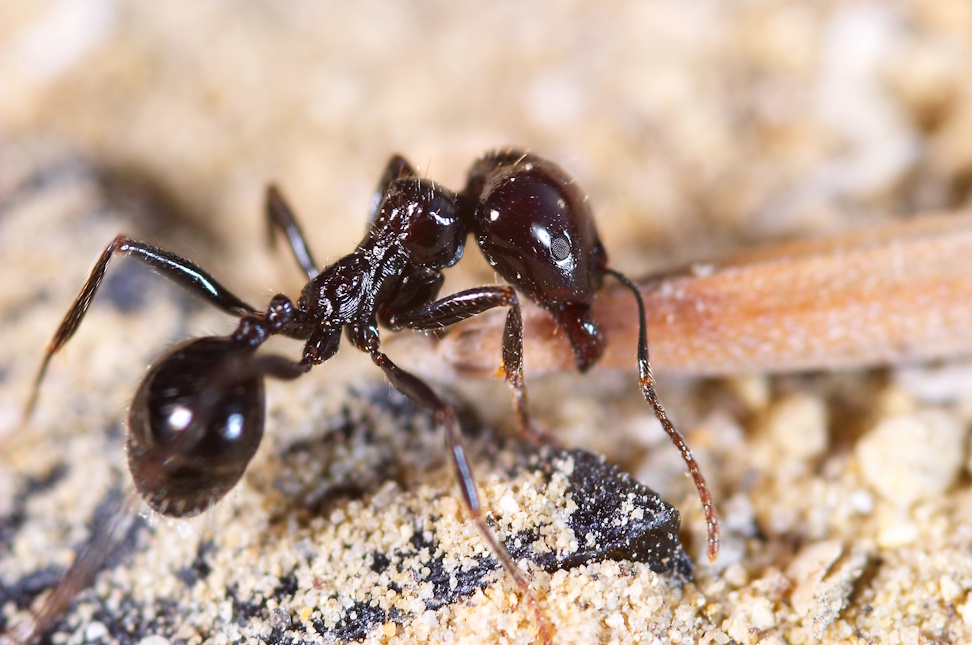
Identification
Very small (1.5–2 mm), color ranges from pale honey to dark chocolate brown. Diagnostic features per Texas A&M: 9-segmented antennae with no club (most household ants have 10–12), single hidden petiole node, and dense, fine body pubescence. Workers move slowly compared with crazy ants. Easily mis-keyed as 'small dark ant' without magnification.
Biology & Colony Structure
Colonies are surprisingly small for a tramp ant, often a single queen and a few hundred to a few thousand workers, but the species compensates by colonizing nearly any small protected harborage: a potted plant, a wall void around a leaky shower, a stack of cardboard, an irrigation valve box. Strongly associated with moisture and fungal decay.
Pest Status & Significance
Persistent indoor nuisance, workers trail in bathrooms, kitchens, and around HVAC condensate lines. Not a stinger, not a structural pest, but reinvasion from outdoor mulch and landscape beds is constant. In the Gulf South, rover ant calls have surpassed odorous house ant calls in some markets.
Rover Ant Control Strategy
Combine sweet liquid bait at every interior trail with a non-repellent perimeter band and aggressive moisture correction. Because colonies are small and scattered, treat each separately rather than expecting a single bait placement to collapse the population.
Recommended Baits & Active Ingredients
Product names are representative of the active-ingredient class and intended for licensed PMPs. Always read and follow the label; rates, sites, and restrictions vary by formulation and state registration.
| Product | Active | Form | Use |
|---|---|---|---|
| Terro PCO Liquid | Borax 5.4% | Liquid | Primary indoor tool, rover ants prefer sweets; refresh every 5–7 days. |
| Optigard Ant Gel | Thiamethoxam 0.010% | Gel | Spot interior cracks; acceptance is variable, rotate with liquid sucrose. |
| Termidor SC | Fipronil 9.1% | Spray | Non-repellent perimeter band, key tool for limiting reinvasion from mulch and landscape beds. |
| Advance 375A | Abamectin B1 0.011% | Granular | Broadcast into landscape beds and mulch around the foundation. |