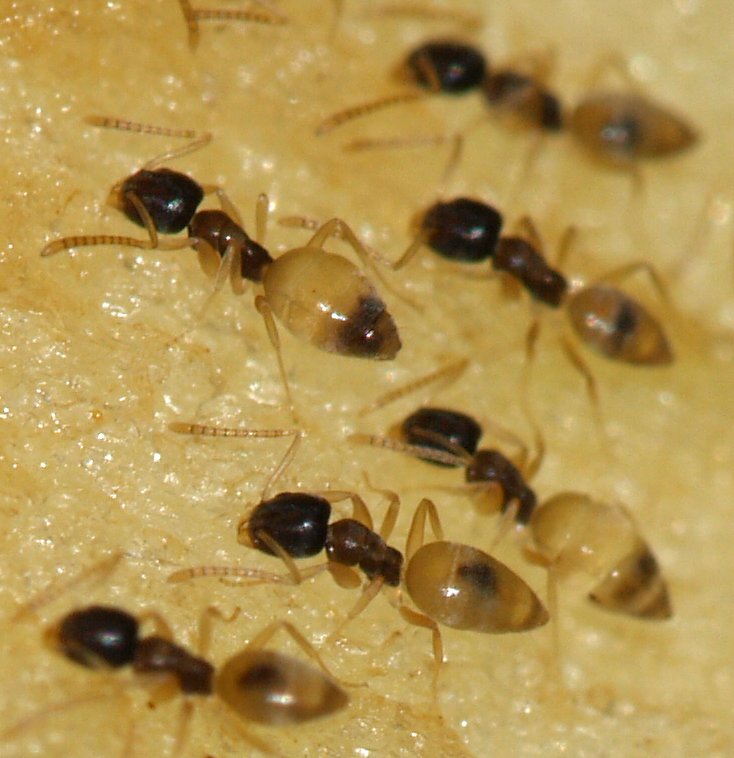
Identification
Very small (1.3–1.5 mm) with a dark brown to black head and thorax abruptly transitioning to a translucent, almost colorless gaster and legs. Single hidden petiole node. Faint coconut-like odor when crushed (related to odorous house ant). The two-tone color is the fastest field ID in the field.
Biology & Colony Structure
Polygyne and polydomous; colonies of several hundred to a few thousand workers split easily into multiple satellite nests across a single structure. Reproduces primarily by budding. Strongly attracted to moisture, bathrooms, kitchens, condensate lines, and potted plants are typical interior nest sites.
Pest Status & Significance
Persistent kitchen and bathroom invader in Florida and the Gulf, often misidentified because workers nearly disappear on light counters. Not medically important but very difficult to eradicate because of budding behavior and concealed nests in plants and voids.
Ghost Ant Control Strategy
Sweet liquid bait at every trail, refreshed often; supplement with non-repellent perimeter band and aggressive management of indoor potted plants (the most common interior reservoir).
Recommended Baits & Active Ingredients
Product names are representative of the active-ingredient class and intended for licensed PMPs. Always read and follow the label; rates, sites, and restrictions vary by formulation and state registration.
| Product | Active | Form | Use |
|---|---|---|---|
| Gourmet Liquid Ant Bait | Borate 1% | Liquid | Primary tool, sucrose acceptance is excellent. |
| Terro PCO Liquid | Borax 5.4% | Liquid | Cost-effective alternative. |
| Optigard Ant Gel | Thiamethoxam 0.010% | Gel | Crack-and-crevice indoor placements. |
| Termidor SC | Fipronil 9.1% | Spray | Non-repellent perimeter band for outdoor populations in Florida and the Gulf. |